Technology Deep Dive
Product Configurators for Custom Orders: Stop Quoting Personalized Products by Email
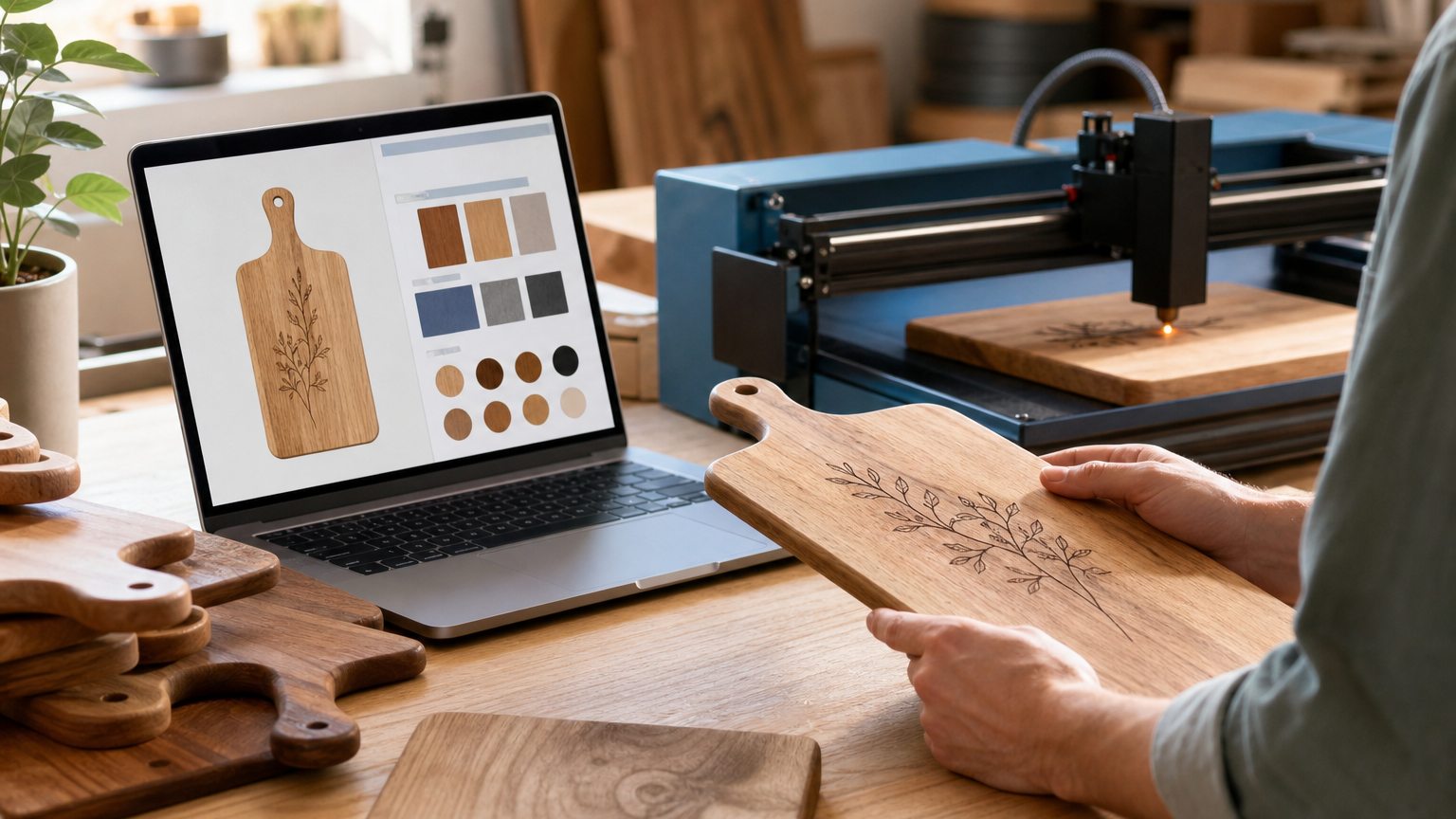
If every custom order starts with an email thread, your best customers are waiting on your busiest people. A configurator turns that thread into a checkout.
The configurator is the storefront. The production handoff behind it is where the hours come back.
"Can you do it in navy? With two lines of text instead of one? And what would 40 of them cost?"
If you sell personalized or made-to-order products, your inbox is full of messages like that. Each one becomes a small project: a reply, a mockup, a price, a revision, an invoice, and finally a note to production that someone has to read correctly. The customer waits a day or two. Some never come back.
A product configurator turns that thread into a checkout. The customer builds the product on the page, sees the price and a preview, and pays. Behind the page, the order arrives already specified, so production doesn't need to ask anything.
Signs You Have Outgrown Email Quoting
A gift-box retailer described the cost in a published case study: "We would spend about 20 hours a week as a team responding to custom gift inquiries in our inbox, designing custom gifts, creating shipping labels, and so on." After launching a custom gift-box creator, the owner put it simply: "People don't email us anymore — they just buy."
- Offer only valid combinations
- Price every option live
- Show a preview the customer trusts
- Produce production-ready output
- Update inventory and fulfillment
Write the Rules Before You Design the Screens
The hardest part of a configurator is not the interface. It is writing down the rules your team applies without thinking. Build a simple options matrix first:
Get the person who runs production to sign off on the matrix. Every invalid combination you allow online becomes a phone call later.
The Production Handoff Is the Payoff
Most configurator projects focus on the customer's preview. The bigger savings are behind it. When a customer finishes a design, the system should produce whatever your makers need: a print file, a cut list, an engraving file, or a spec sheet, attached to the order automatically.
A custom neon sign brand in a published case study built exactly that. Its design tool lets customers preview and personalize signs in real time, and a back-end system "auto-generates print-ready files for every design," which the firm says "reduced manual processing, increased production speed, and improved fulfillment accuracy."
App or Custom Build?
| If your products need... | What usually works |
|---|---|
| Color, size, or engraving text | An off-the-shelf options app |
| Options that rule each other out | A rules engine built on your own data |
| A price built from components | Live pricing from your own price rules |
| Files or specs for production | Automated output attached to each order |
| Stock that each option consumes | Inventory and ERP updates on every order |
A Simple Rollout
Plan for More Demand Than You Expect
Customers often like customizing more than owners predict. The gift-box retailer expected 20 percent of customers to use its creator. Sixty percent did. If custom orders take more labor or more components than standard ones, size your production capacity and component stock for the higher number.
Mistakes to Avoid
What to Measure
By the Numbers
Published industry case studies from software firms show where the time goes. The figures below are self-reported by the firms that published them, and each describes a single project rather than an industry average.
- 63%order growth at a custom neon sign brand after a rebuild built around a personalization tool
- 70%rise in design tool usage at the same brand
- 60%of a gift-box retailer's customers ordered custom gifts, against a predicted 20 percent
- About 20 hrsa week of custom-gift inquiries, design, and label work that the retailer's team got back
Self-reported results from case studies other software firms have published. See Sources & method below.
Page speed at the custom neon sign brand
Before: 3.5sAfter: 2.4s
Self-reported results from case studies other software firms have published. See Sources & method below.
Where does your team sit? The 14-day Ops Efficiency audit measures it. Book the audit
Start With a Systems Review
If custom orders are your best margin and your worst bottleneck, start by mapping how one moves from inquiry to shipment. A systems review finds where the hours go and ranks what to build first. Explore our custom software services or browse more guides on the Delta blog.
Sources & method
- Gift-box retailer, custom gift creator and storefront — published case study (Braid)
- Custom neon sign brand, design tool and production automation — published case study (Commerce Pundit)
Figures are self-reported results from case studies other software firms have published. Delta did not produce these results. Where a source says “up to”, so do we.
FAQ
Frequently Asked Questions

Know a business that’s struggling to keep up with changing customer expectations?
Share this article.
Tell Us What You’re Seeing
How are customer expectations changing in your industry? Share your thoughts privately with Delta Insights.