Business Strategy
Custom Software Vs. Off-the-Shelf: How Growing Companies Should Decide
A growing business often starts with two or three software subscriptions. Accounting uses one, sales has another, and operations employs project management software. All of these are great while the company is small.
But as the company grows, the same old problem crops up. As they start to scale, the sales CRM and the operational delivery system do not talk to each other. So people start to export CSVs from one system and import them into the other. There is a proliferation of Excel files that act as the connective tissue between these systems. After some time, different departments come up with their own processes, and there is no central source of truth about business data anymore.
At this crossroads, executive teams are presented with a crucial decision. The options include continuing to buy subscriptions for new software, replacing existing tools with an end-to-end enterprise solution, building an entirely new toolset, or a mixture of these options.
The choice between custom and off-the-shelf software is never a matter of one being universally better than the other. It depends on the context in which the software has to be used. In particular, it depends on what the software is used for: does it support standardized business processes, or is it essential for implementing proprietary and strategically valuable workflows?
This guide will walk you through evaluating your technology needs, examining them from multiple angles, and calculating the ROI of your software stack decisions to understand which of the two options gives you more value.
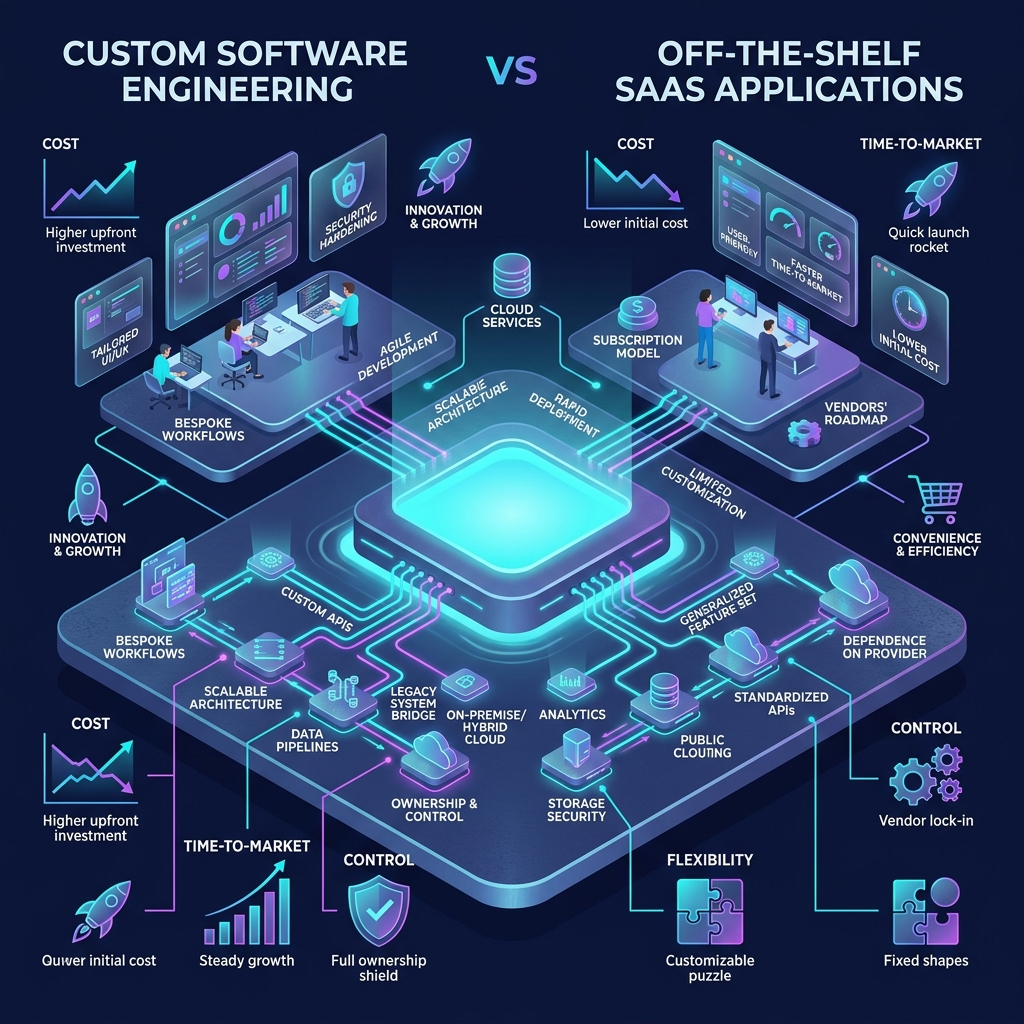
What Is the Difference Between Custom and Off-the-Shelf Software?
To make an informed decision, it is essential to define some terms that classify the available software models.
Off-the-shelf software (also known as software as a service, or SaaS) is proprietary software designed for a broad market. It is distributed commercially as a product for which an organization buys licenses to use it or subscribes to its cloud-based version. Its production is driven by the demands of thousands of companies that use the software, and its development is controlled by the third-party vendor that created it.
Custom software is developed for you, the client. It is made upon your business needs and not the other way around. By investing in the proprietary business software development, you are the one who decides on the specifics of its operation, sets the rules, dictates the functions, and determines its integration and scalability possibilities.
Hybrid systems of software allow for incorporating both methods. A company might buy off-the-shelf accounting software while creating an operational dashboard on its own, to which all different departments would feed data in order to create a proprietary dashboard.
Custom Software vs Off-the-Shelf: Quick Comparison
When considering a build versus buy decision, the leadership of an organization must carefully consider several factors. The following matrix highlights the tradeoffs between the two options.
| Factor | Off-the-Shelf (SaaS) | Custom Software |
|---|---|---|
| Initial deployment | Faster; ready for immediate use. | Requires development time and testing. |
| Upfront investment | Usually lower (monthly/annual fees). | Usually higher (development and architecture). |
| Workflow flexibility | Limited to the vendor's available capabilities. | Built precisely around your business requirements. |
| Custom integrations | Depends on available APIs or third-party connectors. | Can be designed specifically to connect your existing systems. |
| Ownership & control | Vendor dependent; you rent the software. | Greater control; you own the code and the intellectual property. |
| Updates & features | Vendor controlled; features change without your input. | Business-controlled; you build what you need, when you need it. |
| Scalability | Depends entirely on the vendor and platform tier. | Designed from the ground up around your scaling requirements. |
| Differentiation | Limited; your competitors can buy the exact same tool. | Potentially high; your software can create a unique market advantage. |
| Maintenance | Vendor managed (updates, security patches, hosting). | Requires ongoing internal ownership and infrastructure management. |
| Best fit | Standardized processes (email, payroll, basic HR). | Unique, complex, or strategically valuable workflows. |
When Off-the-Shelf Software Is the Better Choice
It is important to note that the fact that custom software is possible does not mean that it should be made. The truth is, there are certain business processes that are better off remaining standardized. In cases where the business process is identical throughout an industry, off-the-shelf software must be purchased.
Situations where buying software is preferable include:
Practical examples of systems that typically should be commoditized include basic accounting software (such as QuickBooks or Xero), standard communication tools (like Google Workspace or Slack), and commoditized HR functions.
When Custom Software Starts Making More Sense
If standard software-as-a-service solutions are so effective at performing their basic functions, why would companies ever build their own systems?
The answer is obvious: as companies mature their processes, their operations tend to become more sophisticated and specific. Off-the-shelf software is often designed around an ideal user and may often not perform as quickly or efficiently for niche applications.
Custom software development for your company is a good investment if you see any of these signs:
Suppose there is an average-sized staffing and recruiting agency. They may well have something like a commercial applicant tracking system and billing software. But if the nuances of their specific way of matching candidates to specialized medical jobs can't be handled by the software, they will turn to Excel.
Such a custom-built "operational layer" on top of the software to handle the peculiarities of the assignment process for these types of jobs will give them a significant competitive advantage over similar agencies that do not use such technologies.
The Hidden Cost of Off-the-Shelf Software
One of the biggest mistakes that executives make is to compare the costs of bespoke software upfront against the SaaS's subscription fee monthly and not consider the Total Cost of Ownership and the expenses related to operational complexity.
A SaaS platform may cost $100 per user per month, but the real cost of off-the-shelf software includes:
A low monthly fee is often misleading since a low subscription price is, in most cases, not equal to a low overall cost. When one needs to employ someone to dedicate 15 hours weekly to manual workarounds for some software, the cost of which is 2,000 per year, this software costs the employer tens of thousands of dollars per year.
The Real Cost of Custom Software
To ensure that they take the objective view needed to make the best decision, managers making the build versus buy choice should also take into account the costs of construction. Building often entails large expenditures and should be considered only when it has been established that it will create substantial business value.
The cost of custom software extends beyond writing code. It includes:
Due to this, it is suggested that custom software should be utilized in the functions of a business process that generate revenue, provide a differentiation to one's service, or create the largest operational expenses.
A Practical Build-vs-Buy Decision Framework
How can a leadership team decide which road to take? Go through these 10 questions to see if your software requirements justify custom development.
1. Is the workflow standardized or unique?
If your process is the same as everyone else in your space, purchase something off the shelf. If your process is what makes you successful, build it.
2. Does the software support a competitive or operational advantage?
Software that helps manage basic payrolls will not get you new clients. Software that enables you to provide your service 40 percent faster than the competition is a huge competitive advantage.
3. How much manual work exists around the current software?
Audit the team's day-to-day process. If they are spending hours and hours transferring information from one program to another or keeping track of extra spreadsheets, then your software is not serving you correctly.
4. How many systems need to exchange data?
You may want to consider building a custom dashboard or data warehouse if you're using five separate SaaS applications without any native integrations.
5. How much are workarounds costing the company?
Calculate how many hours are spent on reporting, double entry, and error correction due to disparate systems and multiply it by the hourly cost of the employees who perform these tasks to get the cost of your software "limitations."
6. How frequently does the workflow change?
If you operate in an industry that demands to adapt to quickly-evolving regulatory or market requirements, relying on a third-party vendor's update schedule is inherently risky.
7. Does the current vendor control your roadmap?
If you can't roll out a new product line or service tier because the billing options of your SaaS platform can't support them, it's holding you back.
8. Is the software becoming a scaling constraint?
If you're going to double your client base, but it'll require tripling your administrative staff to manage the increased paperwork and software limitations, your current system is not scalable.
9. Could the workflow be simplified instead of automated?
Before embarking on custom development, ask yourself if the core business process that the software will automate is, itself, overly complex. Do not automate a bad process!
10. Would a hybrid approach solve the problem?
In most cases, the answer will not be black and white. You may need to implement both commercial and custom-built software with the operational layer on top.
The Hybrid Approach: Buy the Commodity, Build the Differentiator
The most effective technology strategies are likely to favor a hybrid approach over either buying or building alone. The most basic hybrid strategy is to buy standardized functionality and to build functionality that differentiates.
A hybrid strategy is about balancing different alternatives, not about choosing between them. A growing logistics company could be expected to purchase Microsoft 365 for its email and collaboration tools and buy an off-the-shelf accounting software package. However, it may want to develop a custom business platform for its own dispatch and routing needs.
By utilizing secure APIs, the custom operational dashboard can aggregate financial data from the accounting software and communication data from the email software, thus creating an operating system for the business. In this way, the company not only achieves the cost-saving of using commercial software for its basic operations but also retains full control and ownership of the software for its core operations.
7 Signs Your Company Has Outgrown Off-the-Shelf Software
If you are not sure where your company is at, here are some tell-tale signs. If multiple apply, it's probably time to consider a custom solution:
How Delta Technologies Approaches Custom Software Development
For growing companies in Chicago and those managing distributed teams across the country, the challenge of balancing innovation with day-to-day operations means that choosing the right path forward is more than just a question of hiring developers to write code. It requires an experienced technology partner who truly understands business operations.
Delta Technologies is a company of custom software development and AI automation with the vision of displacing fragmented processes and replacing them with the software that drives operations, not the other way around. We are not a reseller of a one-size-fits-all SaaS platform; we build you the operating system for your business.
Our Methodology: Map, Solve, and Build.
Before doing any coding, we perform a Systems Review to understand your current operations. We discover where and how you can benefit from implementing new tools to optimize your processes. Next, we design a solution around the problem and develop what needs to be custom and what can be standardized. Once everything is designed, we start building and deploying the solution in sprints.
This iterative enhancement process, as opposed to a disruptive, multi-year big bang approach, enables organizations to rapidly address mission-critical bottlenecks, unify disparate silos of information into an enterprise-wide information ecosystem, and realize immediate ROI without adversely impacting day-to-day operations.
Regardless of the specific requirements, be it bespoke software development, business process automation, customized dashboard creation, or legacy system modernization, the main purpose remains the same: to deliver you an end product that is entirely built for your needs.
Custom Software vs Off-the-Shelf: Which Is Right for Your Company?
The choice between these options will ultimately be dictated by nature and the volume of the business processes. The decision matrix below outlines the selection criteria:
Choose off-the-shelf when:
Consider custom software when:
Consider a hybrid approach when:
Your software should liberate your team to be their best rather than forcing them to navigate a disparate set of disconnected tools. If your existing technology stack is slowing you down, it could be time to stop retrofitting and start designing your own solution.
FAQ
Frequently Asked Questions

Know a business that’s struggling to keep up with changing customer expectations?
Share this article.
Tell Us What You’re Seeing
How are customer expectations changing in your industry? Share your thoughts privately with Delta Insights.